


Responsible Institution: China Association for Science and Technology
Sponsor: China Ordnance Society
ISSN 1000-1093 CN 11-2176/TJ
Sponsor: China Ordnance Society
ISSN 1000-1093 CN 11-2176/TJ
Acta Armamentarii ›› 2025, Vol. 46 ›› Issue (10): 250505-.doi: 10.12382/bgxb.2025.0505
Previous Articles Next Articles
JIA Di1, CHEN Chuanqing2, LI Xin1,*( )
)
Received:2025-06-16
Online:2025-11-05
Contact:
LI Xin
JIA Di, CHEN Chuanqing, LI Xin. Numerical Simulation Study on the Blast Resistance of Foam Matrix Negative Effective Mass Metamaterials[J]. Acta Armamentarii, 2025, 46(10): 250505-.
Add to citation manager EndNote|Ris|BibTeX
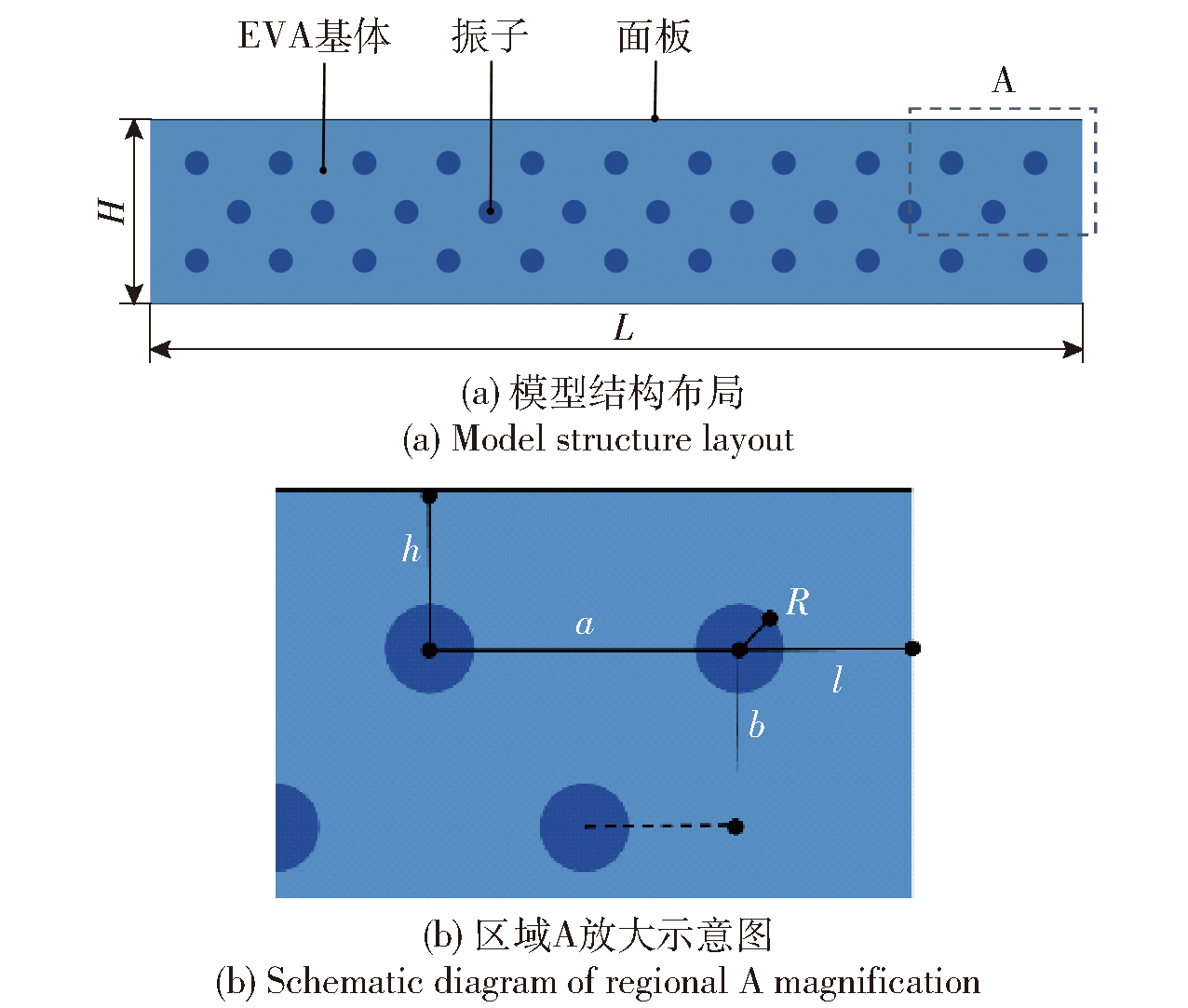
Fig.1 Schematic diagram of model size
| 模型 | 纯EVA | R2 | R4 | R6 | R8 |
|---|---|---|---|---|---|
| 振子半径/mm | 0 | 2 | 4 | 6 | 8 |
| 泡沫尺寸/mm | 308×60×50 (长度×高度×厚度) | ||||
Table 1 Structural geometric parameter table
| 模型 | 纯EVA | R2 | R4 | R6 | R8 |
|---|---|---|---|---|---|
| 振子半径/mm | 0 | 2 | 4 | 6 | 8 |
| 泡沫尺寸/mm | 308×60×50 (长度×高度×厚度) | ||||

Fig.2 Mesh of finite element model
| 材料 | 密度/ (kg·m-3) | 弹性 模量/ GPa | 屈服 应力/ MPa | 泊松 比 | 应变率 参数 C/s-1 | 应变率 参数 P |
|---|---|---|---|---|---|---|
| 不锈钢304 | 7900 | 193 | 310 | 0.3 | 100 | 10 |
| 铝6063 | 2730 | 70 | 48.7 | 0.33 | 128800 | 4 |
Table 2 Material properties of stainless steel 304 and aluminum 6063
| 材料 | 密度/ (kg·m-3) | 弹性 模量/ GPa | 屈服 应力/ MPa | 泊松 比 | 应变率 参数 C/s-1 | 应变率 参数 P |
|---|---|---|---|---|---|---|
| 不锈钢304 | 7900 | 193 | 310 | 0.3 | 100 | 10 |
| 铝6063 | 2730 | 70 | 48.7 | 0.33 | 128800 | 4 |
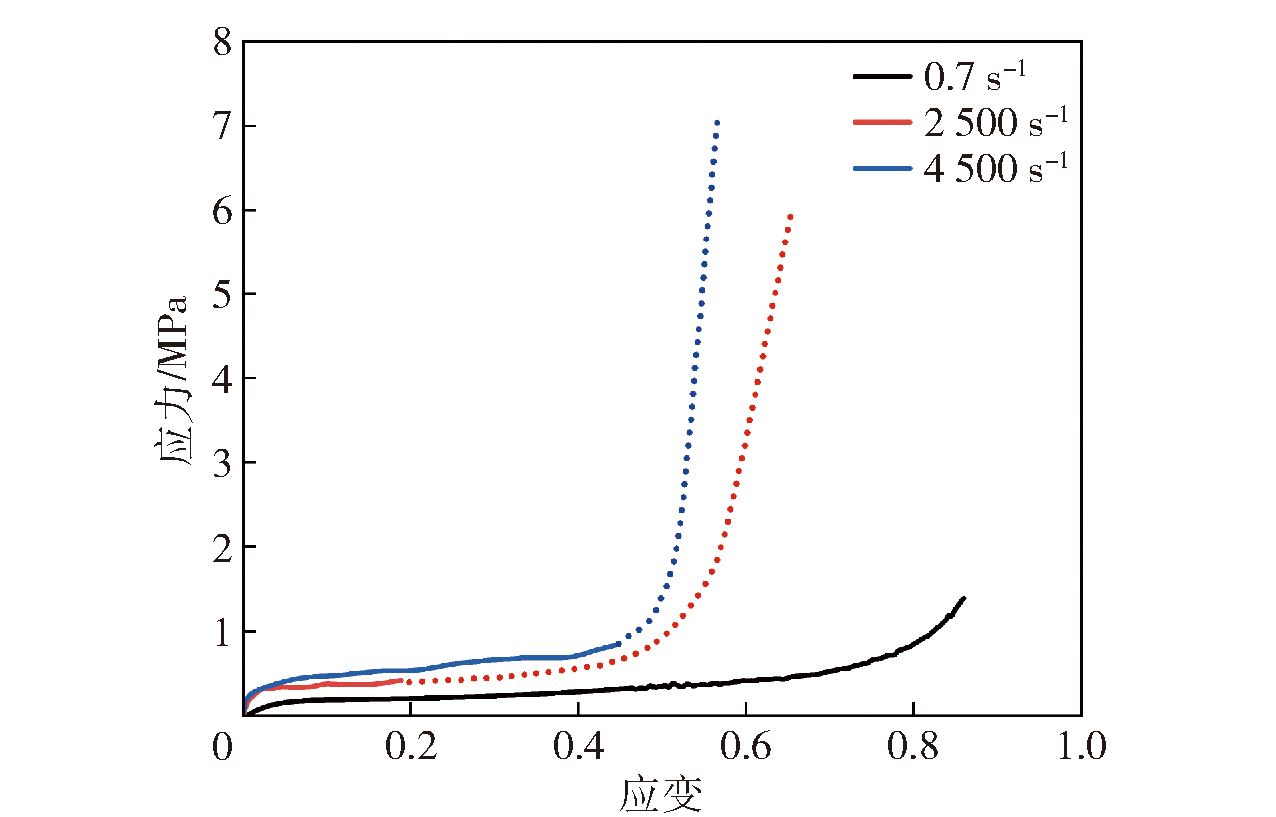
Fig.3 EVA stress-strain curve
| 参数 | A/ Pa | B/ Pa | R1 | R2 | ω | E0/ (J·m-3) | V |
|---|---|---|---|---|---|---|---|
| 数值 | 3.71×10¹¹ | 3.21×10⁹ | 4.15 | 0.95 | 0.3 | 7×10⁹ | 1.0 |
Table 3 Parameters of TNT equation of state
| 参数 | A/ Pa | B/ Pa | R1 | R2 | ω | E0/ (J·m-3) | V |
|---|---|---|---|---|---|---|---|
| 数值 | 3.71×10¹¹ | 3.21×10⁹ | 4.15 | 0.95 | 0.3 | 7×10⁹ | 1.0 |
| 参数 | C0、C1、C2、C3、C6 | C4、C5 | E0/(J·m-3) | V |
|---|---|---|---|---|
| 数值 | 0 | 0.4 | 2.58×10⁵ | 1.0 |
Table 4 Parameters of air equation of state
| 参数 | C0、C1、C2、C3、C6 | C4、C5 | E0/(J·m-3) | V |
|---|---|---|---|---|
| 数值 | 0 | 0.4 | 2.58×10⁵ | 1.0 |

Fig.4 Comparison of numerical simulation and experimental results of structural response process

Fig.5 Comparison of the maximum compression of pure EVA foam model and R2, R4, R6, and R8 models
| 模型 | 纯EVA | R2 | R4 | R6 | R8 |
|---|---|---|---|---|---|
| 前面板峰值/kN | 8.04 | 13.5 | 13.6 | 18 | 24.8 |
| 后面板峰值/kN | 3.85 | 4.06 | 3.13 | 3.02 | 2.97 |
| 传递率/% | 47.9 | 30.1 | 23.0 | 16.7 | 12.0 |
Table 5 The peak contact force between face sheets and core
| 模型 | 纯EVA | R2 | R4 | R6 | R8 |
|---|---|---|---|---|---|
| 前面板峰值/kN | 8.04 | 13.5 | 13.6 | 18 | 24.8 |
| 后面板峰值/kN | 3.85 | 4.06 | 3.13 | 3.02 | 2.97 |
| 传递率/% | 47.9 | 30.1 | 23.0 | 16.7 | 12.0 |

Fig.6 The time-domain contact force between the front and back panels of pure EVA model and R2~R8 model

Fig.7 Frequency domain spectrum of contact force between the front and back panels of pure EVA model and R2~R8 model

Fig.8 Comparison of maximum compression under forward, reverse, and lateral gravity loading for the R4 model

Fig.9 Comparison of contact forces under reverse and lateral gravity loading for the R4 model

Fig.10 Frequency-domain spectra of front and back panel contact forces under reverse and lateral gravity loading for the R4 model
| [1] |
doi: 10.1016/j.compstruct.2024.117916 URL |
| [2] |
doi: 10.1016/j.ijimpeng.2024.104943 URL |
| [3] |
pmid: 10976063 |
| [4] |
|
| [5] |
doi: 10.1016/j.ijengsci.2008.12.007 URL |
| [6] |
doi: 10.1016/j.ijimpeng.2013.09.003 URL |
| [7] |
doi: 10.1063/1.4770370 URL |
| [8] |
doi: 10.1016/j.compstruct.2015.09.048 URL |
| [9] |
doi: 10.1016/j.ijimpeng.2021.103877 URL |
| [10] |
doi: 10.1016/j.ijmecsci.2021.106965 URL |
| [11] |
doi: 10.1016/j.wavemoti.2021.102735 URL |
| [12] |
张恩, 路国运, 杨会伟, 等. 超材料混凝土的带隙特征及对冲击波的衰减效应[J]. 爆炸与冲击, 2020, 40(6): 66-74.
|
|
|
|
| [13] |
方鑫. 非线性声学超材料中弹性波传播理论及其减振应用研究[J]. 机械工程学报, 2020, 56(5): 79.
|
|
|
|
| [14] |
doi: 10.1088/1367-2630/11/1/013003 URL |
| [15] |
doi: 10.1080/15376494.2024.2356072 URL |
| [16] |
周广盼, 王荣, 王明洋, 等. 涂覆聚脲混凝土自锚式悬索桥主梁抗爆性能试验与数值模拟[J]. 兵工学报, 2023, 44(S1):9-25.
doi: 10.12382/bgxb.2023.0863 |
|
|
|
| [17] |
doi: 10.1007/s12289-017-1340-0 URL |
| [18] |
doi: 10.1016/j.tws.2004.11.002 URL |
| [19] |
doi: 10.1115/1.2812345 URL |
| [1] | HUO Ziyi, HE Chenglong, JIA Song, YANG Kexu, MAO Xiang, HUANG Zhixin, PU Yanrong. Energy Dissipation and Damage Assessment of Ceramic/fiber Ballistic Plate under Multi-impacts [J]. Acta Armamentarii, 2025, 46(9): 240807-. |
| [2] | LIU Qiming, FAN Zhengyan, LI Tao, YANG Weilong, HAN Xu. Failure Mechanism of Solder Joints of Projectile-borne Electronic Package under High Overload Environment [J]. Acta Armamentarii, 2025, 46(9): 241006-. |
| [3] | GU Minhui, TANG Kui, WANG Jinxiang, XIA Jingwen, LI Yuanbo, WANG Hongfei. Penetration Fragmentation Characteristics and Damage After-effects of PELE with Slits [J]. Acta Armamentarii, 2025, 46(8): 240898-. |
| [4] | AN Chengyuan, LIU Haipeng, LIU Yan, REN Wei. Shock Wave Power Characteristics of Cylindrical Explosives with Elliptical Cross-section [J]. Acta Armamentarii, 2025, 46(8): 240969-. |
| [5] | WANG Ye, CHEN Huiyan, XI Junqiang, YU Huilong. An Overview of Research on Navigation of Amphibious Vehicle on Water [J]. Acta Armamentarii, 2025, 46(7): 240156-. |
| [6] | LI Qingsong, WANG Lei, ZHAO Ning, ZHANG Xiaotian, ZHANG Lei, WANG Kehong. Finite Element Simulation Analysis and Experimental Study of Arc Additive Frame Structure [J]. Acta Armamentarii, 2025, 46(7): 240629-. |
| [7] | GONG Xiaohui, RAO Guoning, ZHOU Rudong, ZHU Xiaofeng, KONG Decheng, MENG Chenyu. Test and Numerical Simulation of Penetration Resistance of Polyurea/fiber Composite Structures [J]. Acta Armamentarii, 2025, 46(7): 240709-. |
| [8] | YAN Ming, WANG Xinjie, HUANG Fenglei, YOU Sa. Thermal-ignition Response of Warhead Charge and Characteristics of Typical Thermal Protection Structure under Hypersonic Aerodynamic Heating [J]. Acta Armamentarii, 2025, 46(6): 240401-. |
| [9] | WEI Zhenqian, RONG Jili, WEI Huiyang, LI Furong, CHEN Zichao. Dynamic Response and Energy Dissipation of Foam Aluminum Sandwich Panel Subjected to Underwater Impulsive Loading [J]. Acta Armamentarii, 2025, 46(6): 240539-. |
| [10] | ZHANG Qiyue, LIU Yan, YAN Junbo, XU Yingliang, WANG Baichuan, HUANG Fenglei. Dynamic Response of UHPFRC Beams with Different Strengths under Blast Loading [J]. Acta Armamentarii, 2025, 46(2): 240390-. |
| [11] | GUO Dongyang, ZHAO Dongzhi, LIU De, ZHANG Shutong, GAO Muzhu, ZHAO Shuang. Energy Dissipation Mechanism of Fragments Subjected to the Strength-toughness Synergy of Shell Materials [J]. Acta Armamentarii, 2025, 46(11): 250093-. |
| [12] | LIU Xi, MA Tianbao, LI Jian. Numerical Simulation of Refraction of Gaseous Detonation Waves at Temperature Interfaces [J]. Acta Armamentarii, 2025, 46(10): 250377-. |
| [13] | LI Yuan, WANG Tianchi, HOU Bing, SUO Tao, DOU Qingbo. Numerical Modeling on Explosion Protection of Sintered Fiber Network Material [J]. Acta Armamentarii, 2025, 46(10): 250402-. |
| [14] | XIONG Jun, DAI Yijun, GONG Xiangfei, LIU Lufeng. An Improved Efficient Parallel DSD Algorithm and Its Verification & Validation [J]. Acta Armamentarii, 2025, 46(10): 250411-. |
| [15] | YANG Chenchen, LIU Jun, HAN Fanghao, MEI Yue. Research on Dynamic Impact Response and Energy Dissipation Mechanisms of Auxetic Metamaterial Sandwich Structures with Negative Poisson’s Ratio Based on Material Point Method [J]. Acta Armamentarii, 2025, 46(10): 250507-. |
| Viewed | ||||||
|
Full text |
|
|||||
|
Abstract |
|
|||||
