


Responsible Institution: China Association for Science and Technology
Sponsor: China Ordnance Society
ISSN 1000-1093 CN 11-2176/TJ
Sponsor: China Ordnance Society
ISSN 1000-1093 CN 11-2176/TJ
Acta Armamentarii ›› 2025, Vol. 46 ›› Issue (10): 250499-.doi: 10.12382/bgxb.2025.0499
Previous Articles Next Articles
LING Jing, LIANG Yanxiang, JING Lin*( )
)
Received:2025-06-12
Online:2025-11-05
Contact:
JING Lin
CLC Number:
LING Jing, LIANG Yanxiang, JING Lin. Dynamic Impact Mechanics Response and Deformation Mechanisms of Al15(CoCrFeNi)85 High-entropy Alloy[J]. Acta Armamentarii, 2025, 46(10): 250499-.
Add to citation manager EndNote|Ris|BibTeX

Fig.1 Sampling and experimental methods of Al15(CoCrFeNi)85 high-entropy alloy
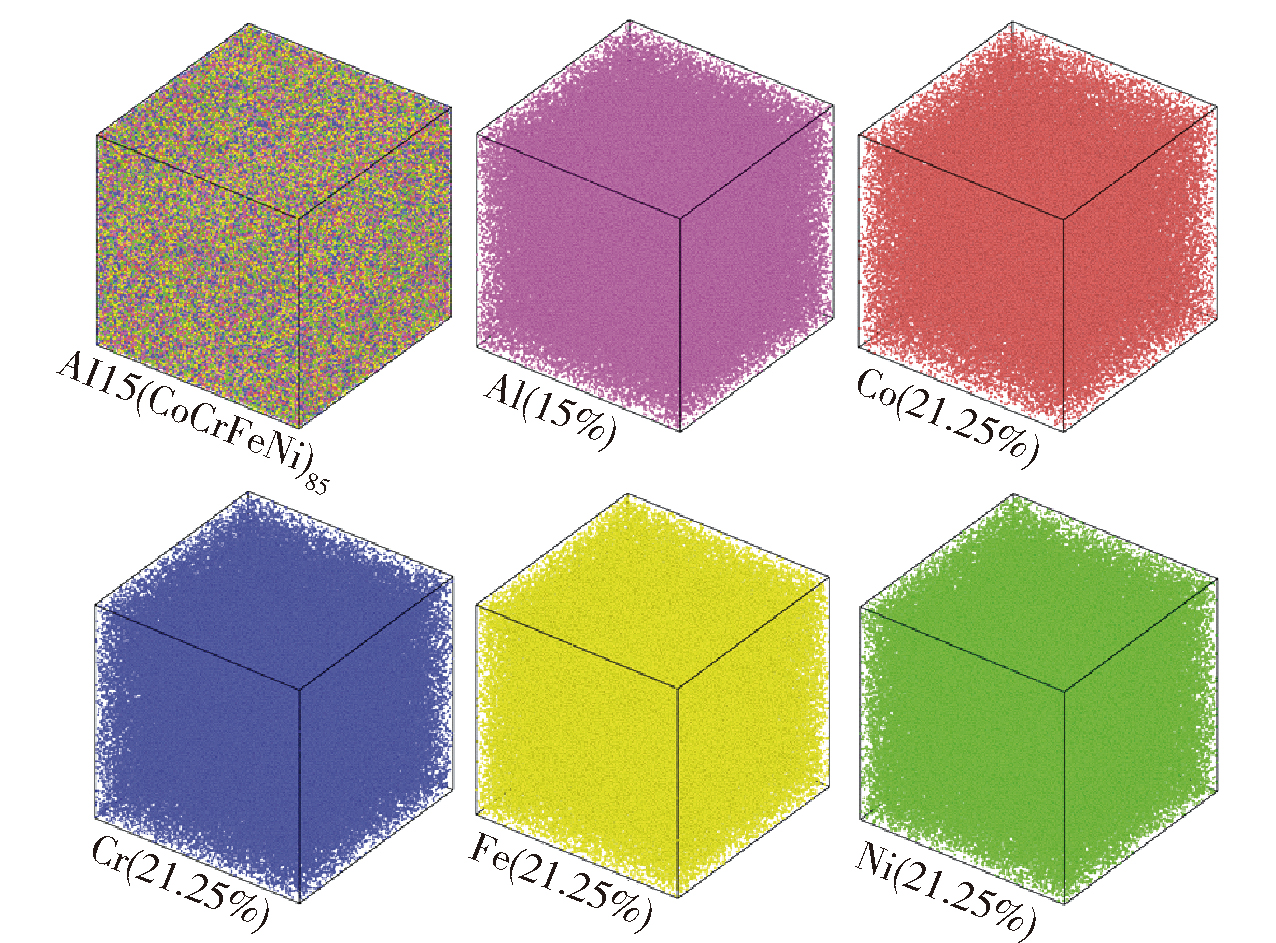
Fig.2 Schematic diagram of molecular dynamics simulation model for single-crystal Al15(CoCrFeNi)85 high-entropy alloy

Fig.3 Stress-strain responses of Al15(CoCrFeNi)85 hig-hentropy alloy at different strain rates

Fig.4 Phase and grain boundary diagrams of Al15(CoCrFeNi)85 high-entropy alloy at different strain rates

Fig.5 Orientation and local strain distribution of Al15(CoCrFeNi)85 high-entropy alloy at different strain rates

Fig.6 Microstructure evolution of Al15(CoCrFeNi)85 high-entropy alloy at different strain rates

Fig.7 LAM distribution of Al15(CoCrFeNi)85 high-entropy alloy at different strain rates
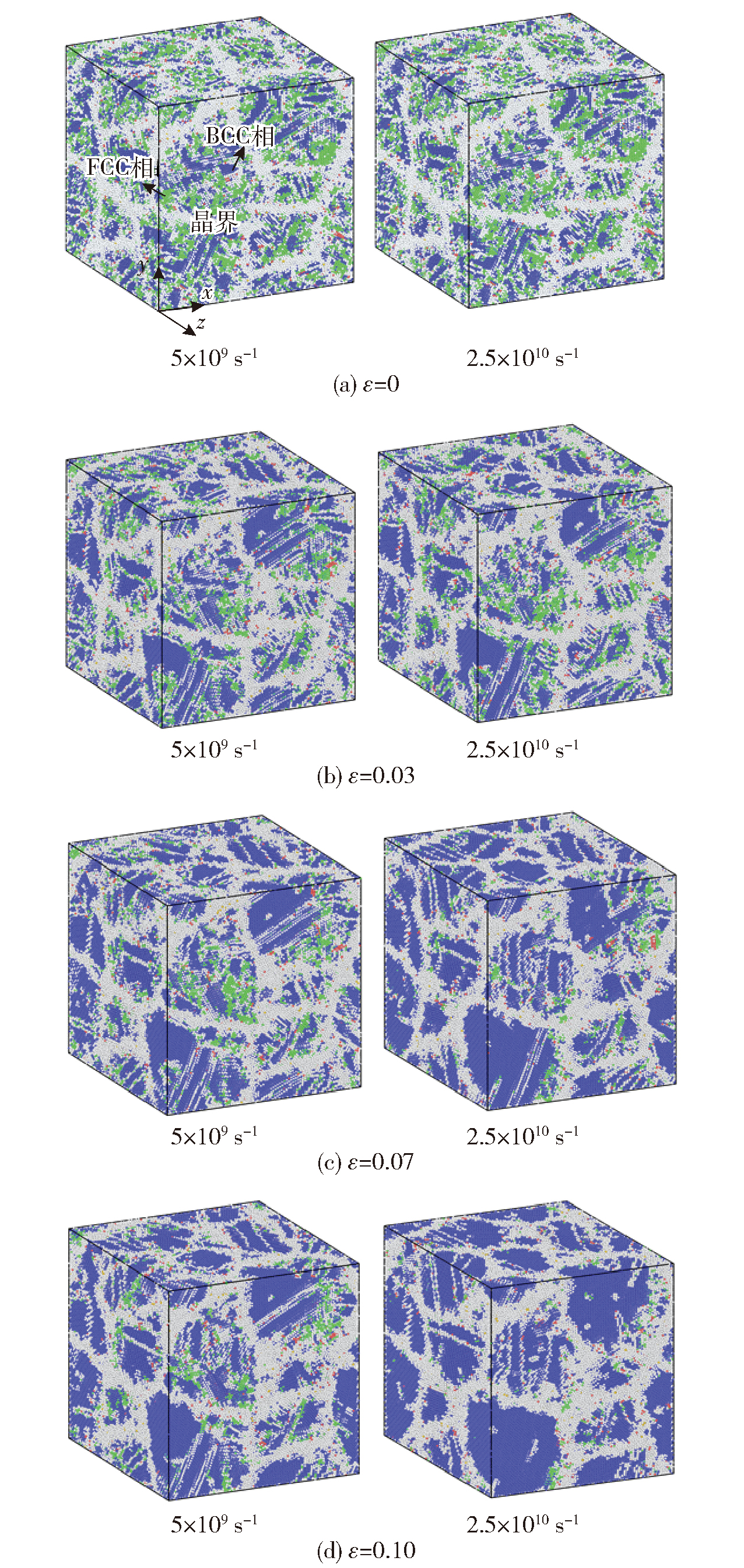
Fig.8 Atomic snapshots of microstructural evolution in Al15(CoCrFeNi)85 high-entropy alloy at different strain rates

Fig.9 Lattice atom ratio versus strain in Al15(CoCrFeNi)85 high-entropy alloy models at different strain rates
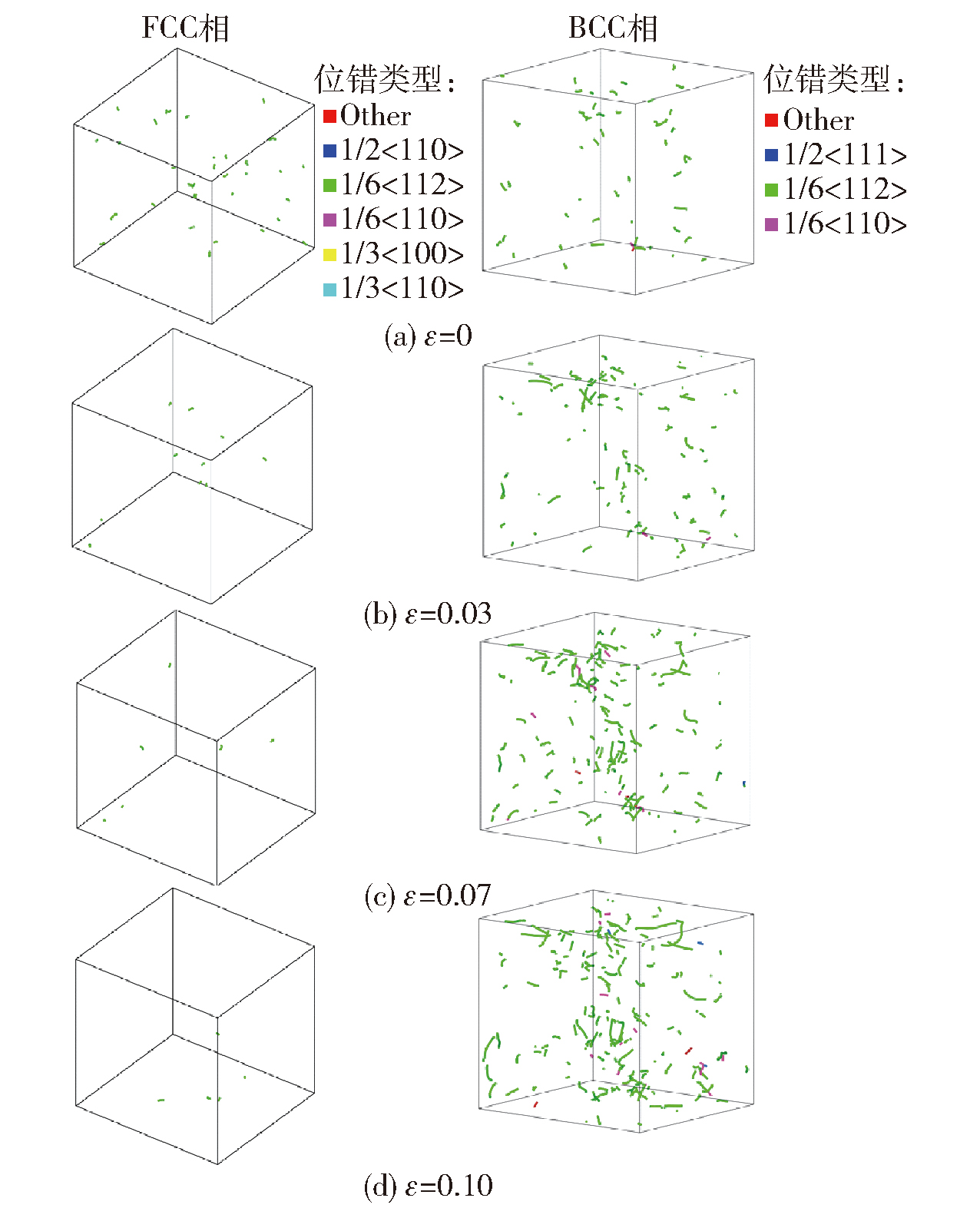
Fig.10 Dislocation evolution in different phases of Al15(CoCrFeNi)85 high-entropy alloy under compressive loading at 5×10⁹s-1
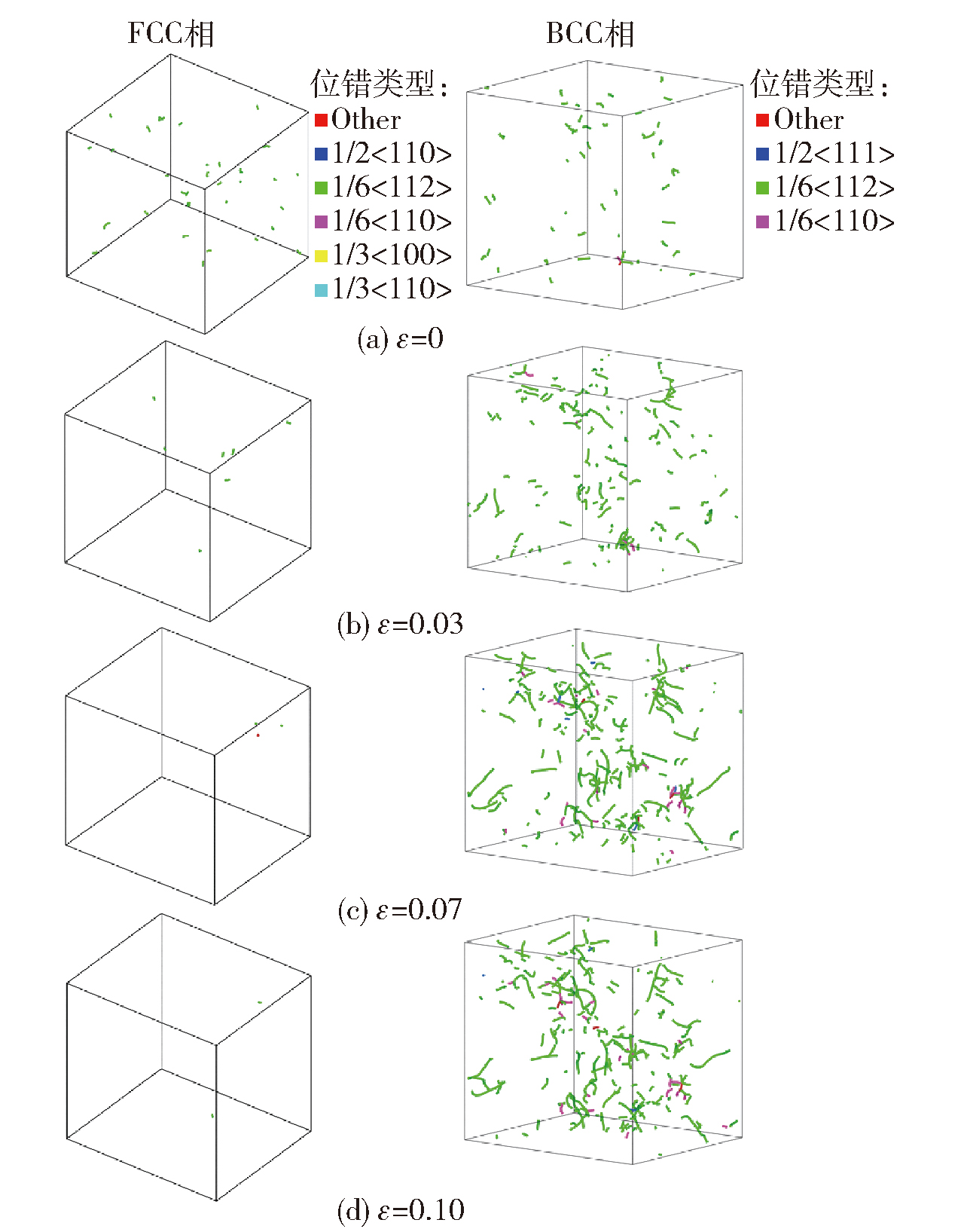
Fig.11 Dislocation evolution in different phases of Al15(CoCrFeNi)85 high-entropy alloy under compressive loading at 2.5×10¹⁰s-1
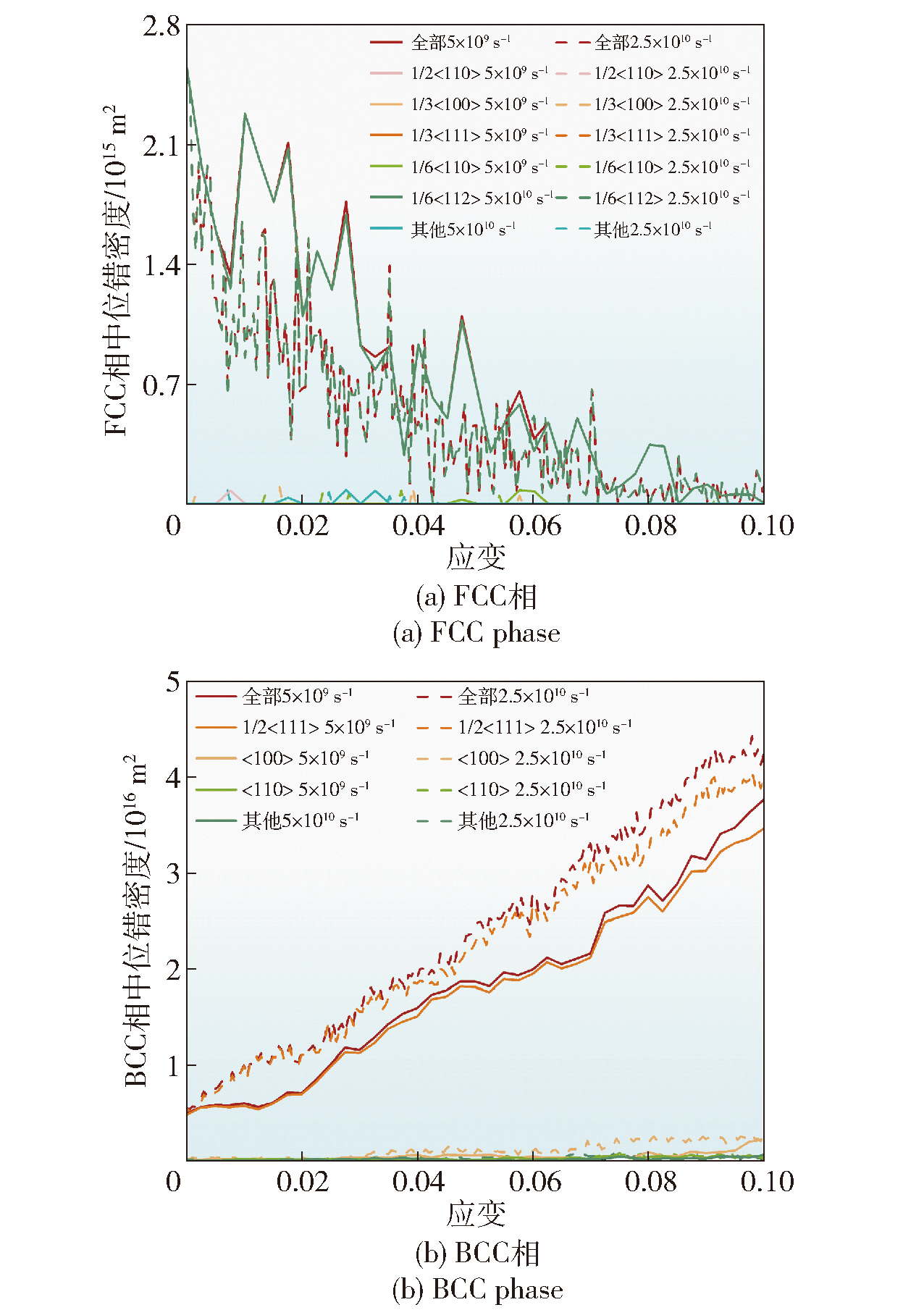
Fig.12 Dislocation density-strain relationship of Al15(CoCrFeNi)85 high-entropy alloy at different strain rates

Fig.13 Relationship between thestrain rate sensitivity coefficient C and the dimensionless strain rate ${\stackrel{·}{\epsilon }}^{*}$

Fig.14 Comparison between model predicted and experimental compressive stress-strain responses of Al15(CoCrFeNi)85 high-entropy alloy at different train rates
| [1] |
doi: 10.1002/adem.v6:5 URL |
| [2] |
doi: 10.1016/j.actamat.2016.08.081 URL |
| [3] |
doi: 10.1016/j.pnsc.2020.11.006 URL |
| [4] |
高茂国, 刘睿, 郭岩松, 等. HfZrTiTaAl系高熵合金动态变形、损伤及破坏行为[J]. 兵工学报, 2025, 46(1):290-300.
|
|
|
|
| [5] |
|
| [6] |
doi: 10.1016/j.msea.2015.09.034 URL |
| [7] |
doi: 10.1038/s43246-024-00450-2 |
| [8] |
doi: 10.1016/j.jallcom.2021.163218 URL |
| [9] |
doi: 10.1038/srep42742 |
| [10] |
doi: 10.1016/j.msea.2018.10.021 URL |
| [11] |
|
| [12] |
doi: 10.1038/s41467-018-03846-0 pmid: 29636478 |
| [13] |
doi: 10.1016/j.pnsc.2024.04.007 URL |
| [14] |
|
| [15] |
doi: 10.1016/j.msea.2017.09.089 URL |
| [16] |
doi: 10.1016/j.msea.2018.05.054 URL |
| [17] |
doi: 10.1016/j.msea.2024.147572 URL |
| [18] |
|
| [19] |
doi: 10.1103/PhysRevB.69.144113 URL |
| [20] |
doi: 10.1088/0965-0393/18/1/015012 URL |
| [21] |
|
| [22] |
doi: 10.1016/j.engfracmech.2022.108839 URL |
| [23] |
doi: 10.1016/j.pnsc.2020.01.012 URL |
| [24] |
doi: 10.1007/s11431-019-1517-8 |
| [25] |
doi: 10.1016/j.actamat.2009.12.013 URL |
| [26] |
doi: 10.1016/j.actamat.2024.120120 URL |
| [27] |
doi: 10.1016/j.msea.2023.144577 URL |
| [28] |
敬霖, 冯超, 苏兴亚, 等. 高速动车组D2车轮钢的率温耦合变形机理与本构关系[J]. 科学通报, 2022, 67(34): 4068-4079.
|
|
|
| [1] | FU Liheng, YAO Xiangyang, WANG Luqing, MA Honghao, QI Feng. The Dynamic Mechanical Properties and Constitutive Model of Fiber-reinforced Polyurea Materials [J]. Acta Armamentarii, 2025, 46(11): 250073-. |
| [2] | WANG Shengfang, CHANG Hui, JIAO Zhiming, YIN Yunfei, ZHANG Tuanwei, LI Zhiqiang, WANG Zhihua. Study on the Damage Effect and Debris Cloud Characteristics of Reactive Fragments of High-entropy Alloys [J]. Acta Armamentarii, 2025, 46(10): 250482-. |
| [3] | ZHANG Wenwen, ZHAO Dan, ZHAO Weitao, WANG Qiang, WANG Jianjun, MA Shengguo, ZHANG Tuanwei, WANG Zhihua. Crystal Plasticity Model of Precipitation Strengthening of CoCrNi-based High-entropy Alloys: Mechanical Properties and Texture Evolution [J]. Acta Armamentarii, 2025, 46(10): 250110-. |
| [4] | GAO Maoguo, LIU Rui, GUO Yansong, GENG Hengheng, CHEN Pengwan. Dynamic Deformation,Damage and Failure Behaviors of High-entropy HfZrTiTaAl Alloy [J]. Acta Armamentarii, 2025, 46(1): 231183-. |
| [5] | LI Yifan, FU Jiawei, YANG Diao, LI Yanze. Effect of Inner Bore Structure of a Large-caliber Gun on the Inner Wall Loadings of Barrel during Engraving Process [J]. Acta Armamentarii, 2024, 45(11): 4106-4118. |
| [6] | REN Xiao-ting, YE Dan-yang, DING Ning, HE Jin-xuan, LU Yan-hua, LEI Qing, GUO Ying-yuan. A Molecular Dynamics Simulation of Solvent Effects on the Crystal Morphology of FOX-7 [J]. Acta Armamentarii, 2015, 36(2): 272-278. |
| [7] | YANG Dong-li, XU Zheng-guo, YANG Jie, WANG Lin, YANG Yuan-sheng. Effects of Relative Density of Magnesium Alloy Foams on Their Dynamic Mechanical Properties [J]. Acta Armamentarii, 2013, 34(10): 1286-1290. |
| [8] | QI Xiao-fei1, ZHANG Xiao-hong1, LI Ji-zhen1, LIU Fang-li1, SONG Zhen-wei1, ZHANG Jun-ping2. Molecular Dynamics Simulation of NC/NG Blends [J]. Acta Armamentarii, 2013, 34(1): 93-99. |
| Viewed | ||||||
|
Full text |
|
|||||
|
Abstract |
|
|||||
